An Evidence Layer Is Only as Good as What It Can Reach
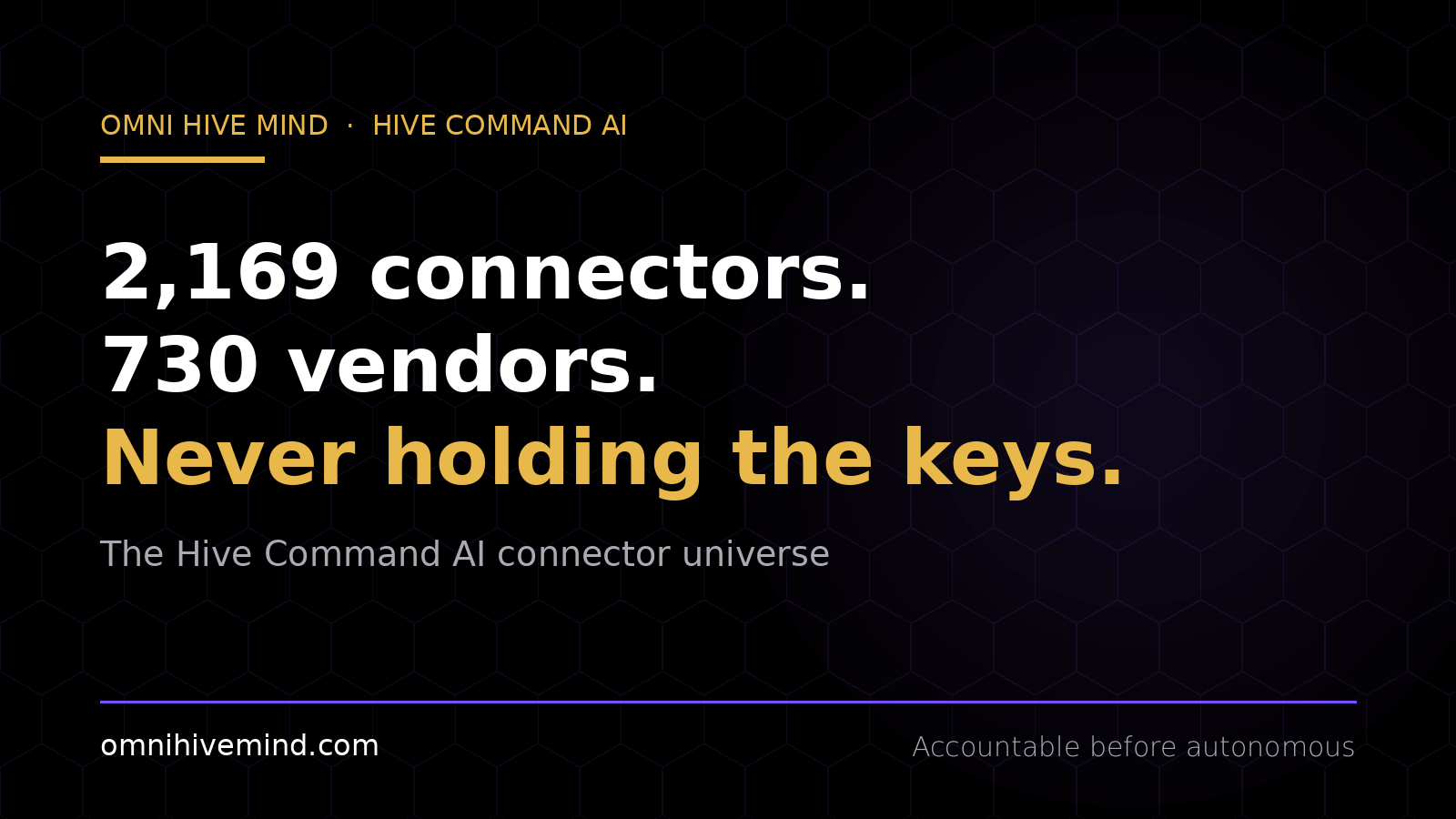
A golden record is only as trustworthy as the sources behind it. If the evidence layer cannot reach the vault, the directory, the endpoint console or the cloud account, it is reconciling a partial view and calling it the truth. So the question we get from every architect is a fair one: what can Hive Command AI actually connect to?
Ten domains, 730 vendors
The Hive Command AI connector universe covers 2,169 connector rows across 730 vendors, organized into ten enterprise domains: credential vaults and PAM; identity and IAM; MDM and UEM; endpoint and EDR; network and network security; cloud, virtualization and infrastructure as code; ITSM, CMDB and ITAM; observability, SIEM and AIOps; vulnerability, CNAPP and attack surface management; and enterprise SaaS. Behind the catalog sits a 132-connector API registry that the platform uses to generate its integrations rather than hand-build them.
Coverage that broad is only useful if it is built on rules that hold everywhere. We hold to three.
Registry first
Every platform in the connector universe is metadata in a registry, not a hand-coded one-off. A connector profile describes how to reach the system, what it can provide, what scopes it needs and what it must never be given. Dashboards are generated from the connector profile and the schema of the data actually ingested, which means a new source shows up with working views instead of a backlog ticket. It also means the same rules apply to the seven-hundredth vendor as to the first.
Universal coverage
No catalog will ever name every piece of software an enterprise runs. For the platforms nobody has modeled yet, protocol adapters step in: REST, GraphQL, SCIM, LDAP, JDBC and ODBC, CSV and XLSX, syslog, SNMP, OpenTelemetry, and OCSF and ECS. If a system can export a file, answer a query or emit a log, it can contribute evidence. The registry treats an adapter-backed source the same way it treats a first-class connector, so the golden record does not care how the fact arrived, only where it came from and how confident the platform is in it.
Read-only first
The third rule is the one that lets the other two exist. Connectors are read-only first. There are no destructive actions in the collection path, no plaintext secrets anywhere in the pipeline, and credentials are handled as references and vault integrations only. Where a system truly requires authentication, the credential broker issues a scoped read-only grant, and the raw secret never reaches a collector, a report or a model. Live writeback, when a customer wants it at all, stays off until a named human turns it on.
What it adds up to
If your platform is in the enterprise, the goal is that we can see it without ever holding its keys. That is what makes broad coverage safe to ask for: the more systems the evidence layer reaches, the fewer blind spots remain, and none of that reach comes at the cost of a new credential in a new place.
We would rather demonstrate this on your estate than describe it. Paid 90-day pilots run on our portable racks or in your environment, with your real connectors and your real evidence, and the pilot fee is credited toward a subscription signed within 60 days. Request one at https://www.omnihivemind.com/contact.
Share this post: LinkedIn · X · Facebook · Email · Follow us on Instagram