Accountable Before Autonomous: What Governed AI Looks Like in IT Operations
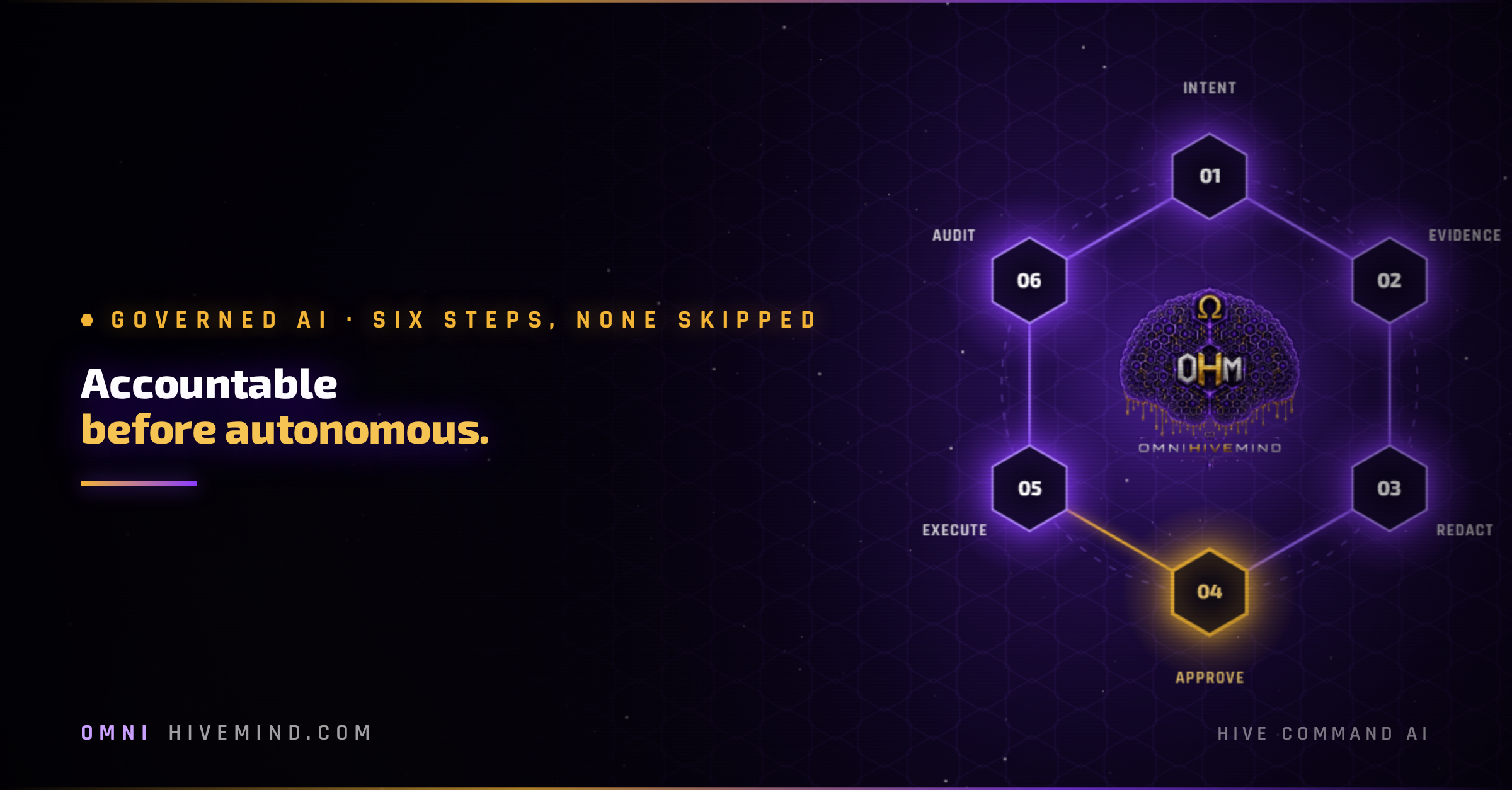
The phrase "AI-powered operations" now appears in nearly every enterprise IT product pitch. Very few of those pitches explain what happens between the moment an assistant decides to do something and the moment it does it. That gap is where the risk lives, and it is the gap we designed Hive Command AI around. Our operating principle is four words long: accountable before autonomous.
The credential problem nobody wants to talk about
Ask a simple question of any AI assistant being deployed into an operations environment: what credentials does it hold? The honest answer, far too often, is "the ones the integration needed to work," which in practice means a service account with broad read and write scope across consoles, cloud accounts, directories and, increasingly, the ERP itself.
The correct number of credentials an AI assistant should ever hold is zero. Not fewer. Zero. Secrets, device credentials, ERP credentials, passwords, tokens, keys, cookies, SNMP community strings and vault contents should be blocked scopes: never in a prompt, never in a log, never in a report, never in a model's context. If a model cannot see a secret, it cannot leak one, and it cannot be tricked into using one.
This is not a limitation on what AI can do for operations. It is the precondition for letting it do anything at all.
Six steps between intent and action
When Hive Command AI receives a request that could lead to a change, it follows a fixed sequence. Each step is logged, and none can be skipped.
The intent is classified first. Is this a read, a recommendation, a simulated change or a real one? What scope does it touch? A request to "clean up unused firewall rules" and a request to "list unused firewall rules" look similar to a language model and are entirely different in consequence.
Evidence is assembled second. The platform gathers the golden records, dependencies, ownership and recent history relevant to the intent. The model reasons over evidence the platform has already reconciled, not over whatever it can scrape from live systems.
Redaction is applied third. Before anything reaches a model, a redaction profile strips what that provider is not permitted to see. Sharing is deny-by-default: a provider receives nothing unless a policy explicitly allows it. Different providers can have different profiles. An air-gapped estate can use a local inference tier and share nothing externally at all.
Human approval is fourth. Any action intent is presented to a named person with the evidence and the simulation of its effect. The person approves, edits or rejects. There is no configuration in which this step is bypassed for a live change.
Brokered execution is fifth. If approved, the action is executed by the platform's credential broker under a scoped grant, not by the model and not with a credential the model has ever seen. Live writeback stays off until a named human turns it on.
The audit record is sixth. Intent, evidence, redaction applied, approver, execution result and timestamp are written as a single traceable record. Audit packs draw from these records directly.
Twenty-one providers, one policy layer
Enterprises will not standardize on a single AI provider, and they should not have to. The governed AI services in Hive Command AI sit in front of a catalog of twenty-one providers, with the same intent classification, redaction and approval workflow applied regardless of which model answers. Teams can use the model that fits the task while the organization keeps one set of controls, one audit trail and one answer to the question "what did we share and with whom?"
For disconnected environments, the same controls apply to an offline local-inference tier, so the governance model does not weaken when the network does.
Why we chose the slower path
It would be easier to sell an assistant that "just does it." We think that product will exist in many forms, and we think most of them will be turned off after their first serious incident. The organizations we work with run networks, cloud estates, identity systems and ERP platforms where a confident mistake can cost more than a year of the manual work the assistant was meant to replace.
Human authority over automation is a value, not a feature toggle. Security by construction means the safe path is the only path, not the recommended one. Evidence over opinion means the model earns trust by showing its sources, the same way we expect a good engineer to.
Accountable before autonomous. If a platform cannot show you the six steps, ask what it is doing instead.
Share this post: LinkedIn · X · Facebook · Email · Follow us on Instagram