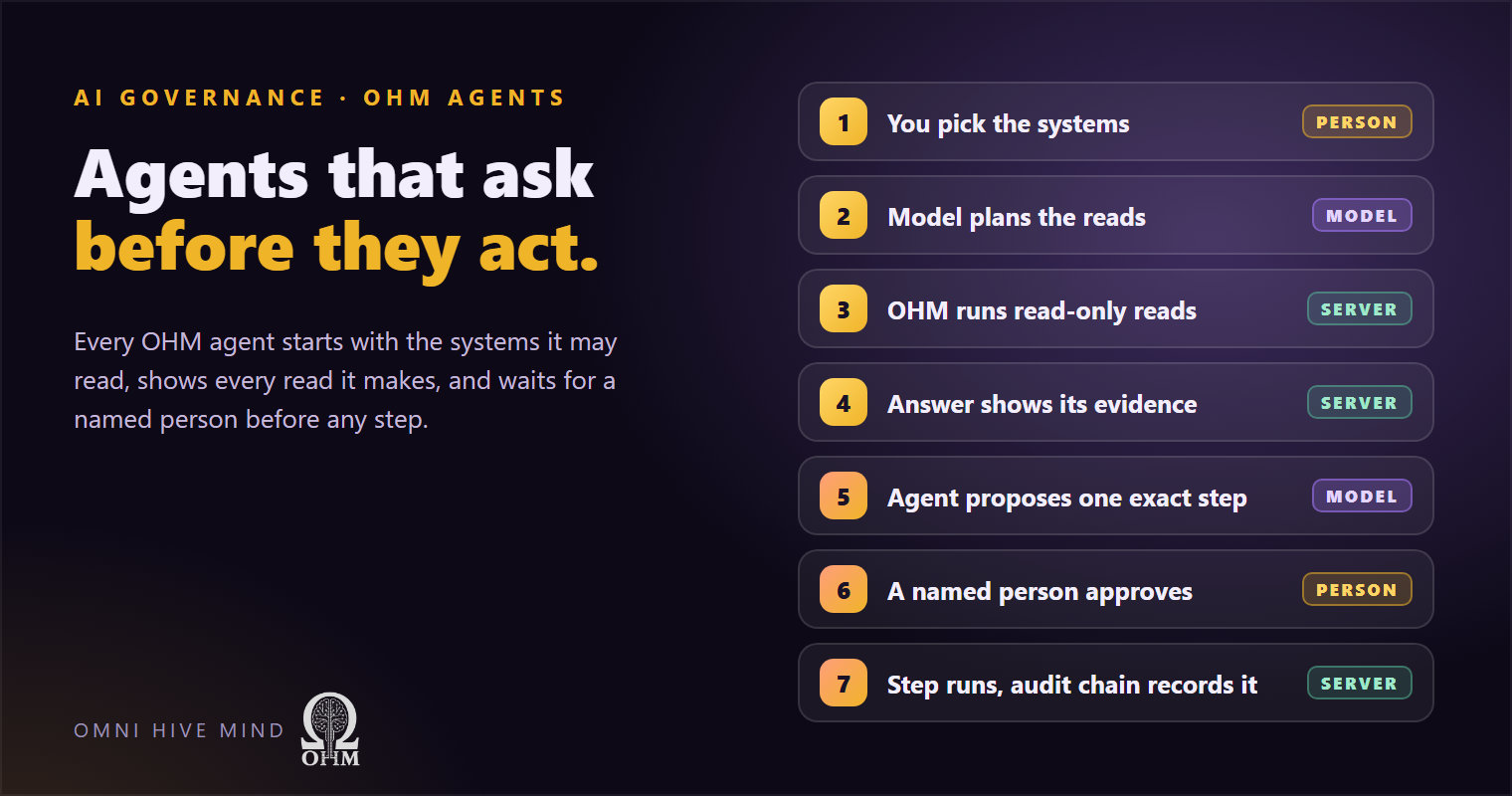
The phrase "AI agent" now shows up in almost every enterprise software pitch. Most of those agents start the same way: someone writes a prompt, connects a few systems, and hopes the model follows the instructions. When it doesn't, the only record of what went wrong is the conversation itself.
We built agents into OHM the other way round. Every OHM agent starts with one question: which systems may it read? It reads only what you allow, it shows every read it makes, and it waits for a named person before it takes a step. The controls live in the platform, not in a prompt.
Start with the systems, not the prompt
Before an OHM agent runs, you choose its connectors: SAP S/4HANA Finance, ServiceNow, Microsoft Dynamics 365, Oracle NetSuite, Tenable, CrowdStrike and the rest of the estate OHM already knows. If you choose none, the agent does not run. The server checks this on every turn. It is not a sentence in a prompt that a model might ignore.
The agent then reads only from OHM's stored, read-only copies of those systems. It does not reach into the live systems of record themselves. Picking SAP S/4HANA Finance and ServiceNow means the agent can see the finance ledger and the service records OHM has gathered from them, and nothing else.
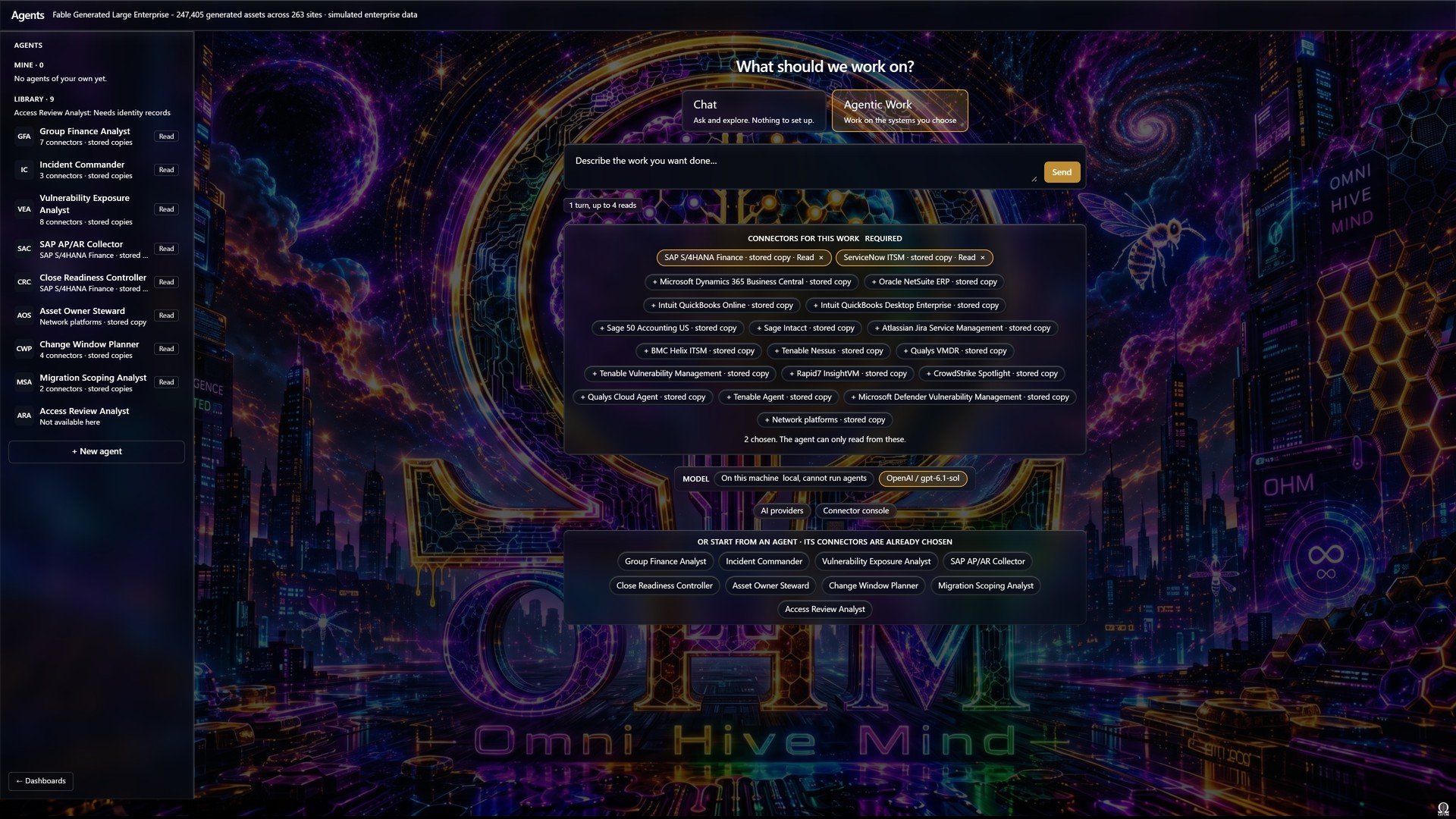
Agentic Work: choose the systems the agent may read. No connector, no run.
See the whole agent on one screen
Each agent is laid out as a flow you can read at a glance: start, brief, connectors, model and starter questions. Nothing is hidden in a prompt you can't see.
The brief is not one long block of instructions. It has separate fields: what the agent is for, the tasks it may do, the tasks it must never do, your business rules, the end states that count as done, and the reply it gives when a question is out of scope. Because these are fields and not free text, the platform can check them.
You can build your own agent from scratch, or start from a ready-made one: Group Finance Analyst, SAP AP/AR Collector, Close Readiness Controller, Incident Commander, Vulnerability Exposure Analyst, Asset Owner Steward, Change Window Planner and Migration Scoping Analyst. Each ready-made agent arrives with its connectors already chosen.
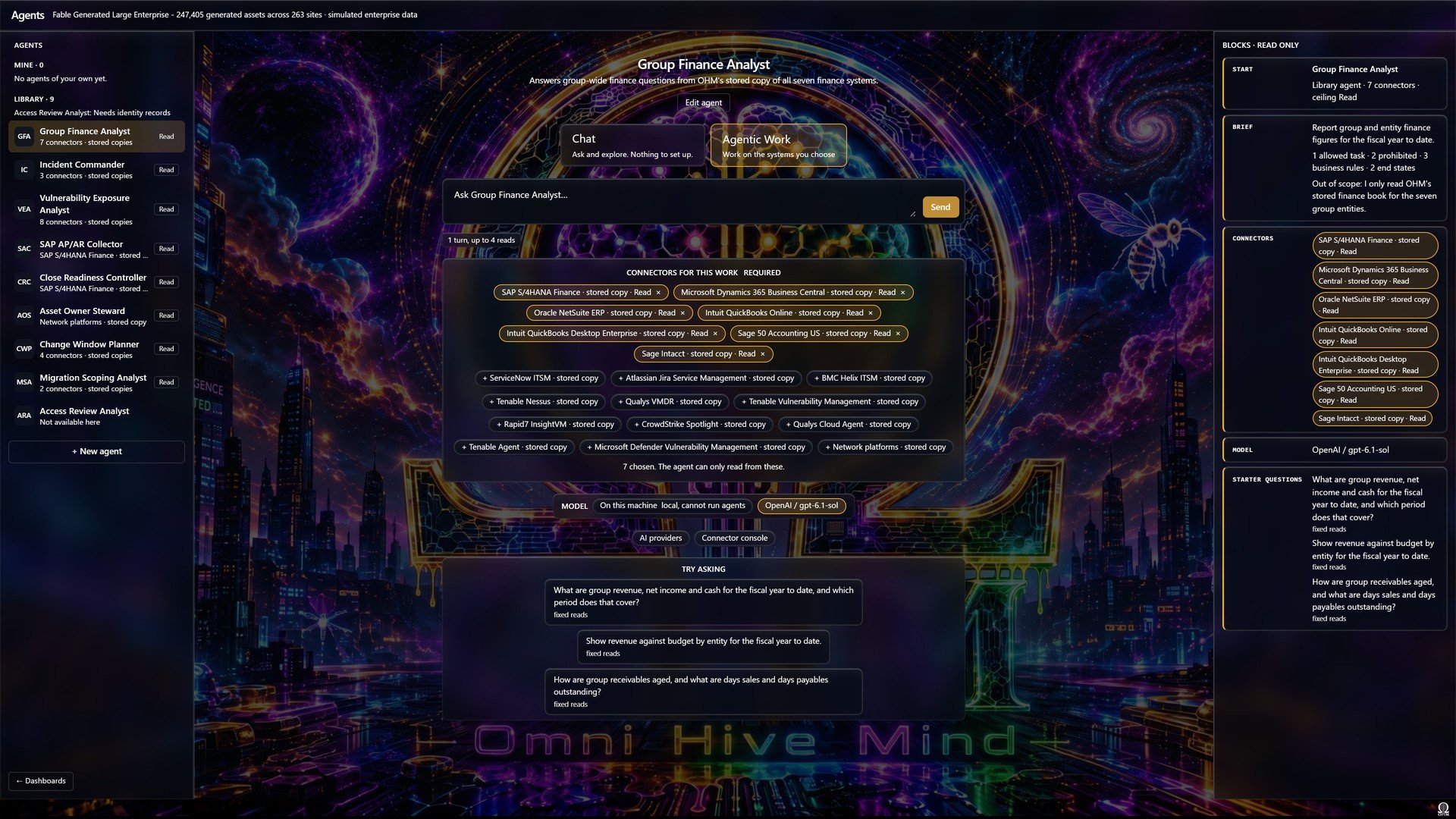
Group Finance Analyst, laid out as a flow: start, brief, connectors, model and starter questions.
Answers you can check
Every Agentic Work answer comes with its trace. You see the reads the model planned and the reads the server actually ran, with the system, the number of rows and the date of the data. If an answer says the group has a certain amount in receivables, you can see which system that figure came from and how fresh it is.
Starter questions go one step further. They run fixed reads, so the same question asked twice gets the same evidence. That matters when a finance lead and an auditor need to look at the same number.
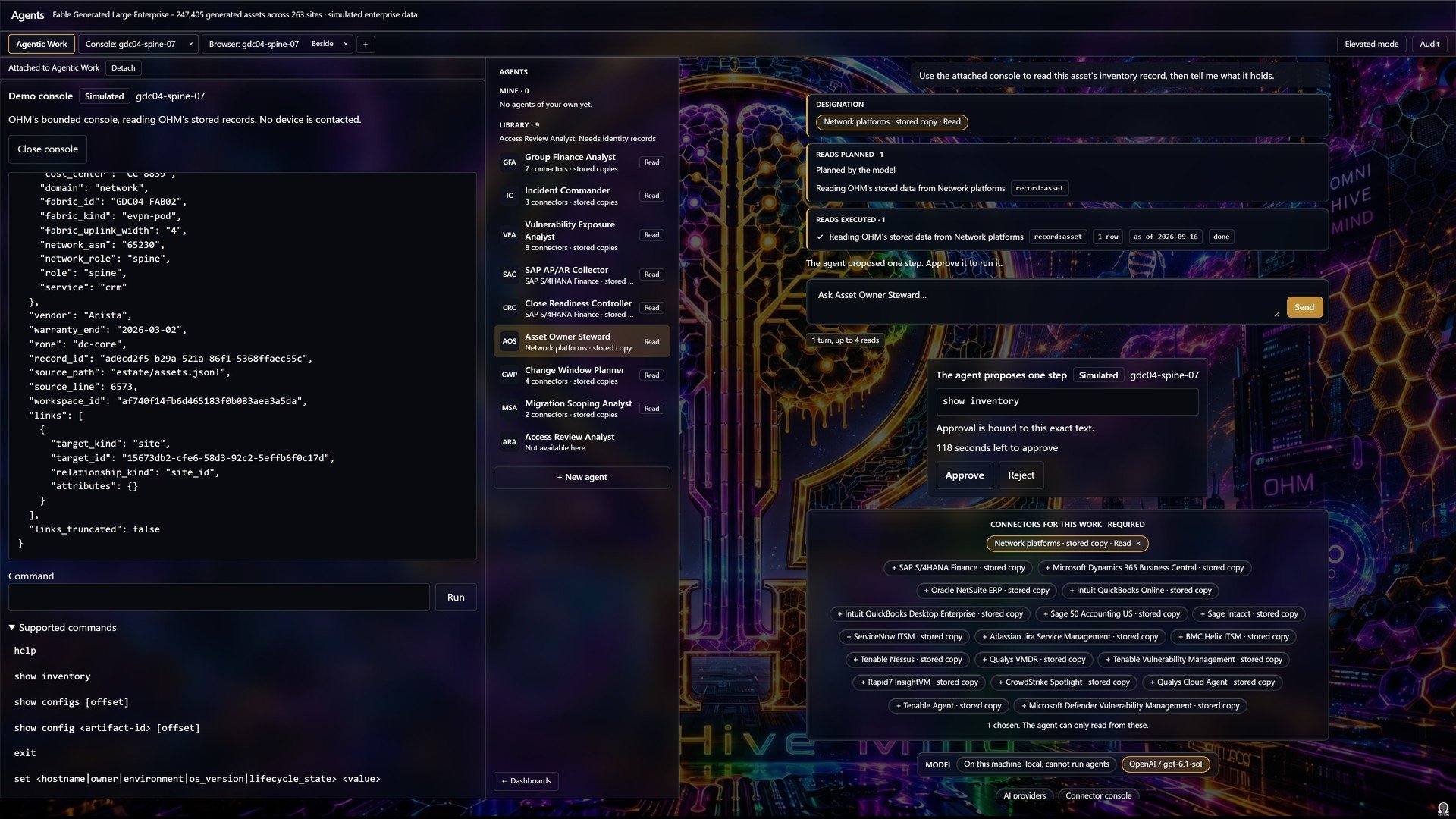
Reads planned and reads run, then one proposed step waiting for a person to approve it. The console is simulated.
A workbench beside the conversation
Agentic Work sits in a workbench with tabs and a split view. You can open a console or an asset's management page right beside the conversation, attach it to the agent, and keep both in view. The agent works on the asset you picked, and you can see what it sees.
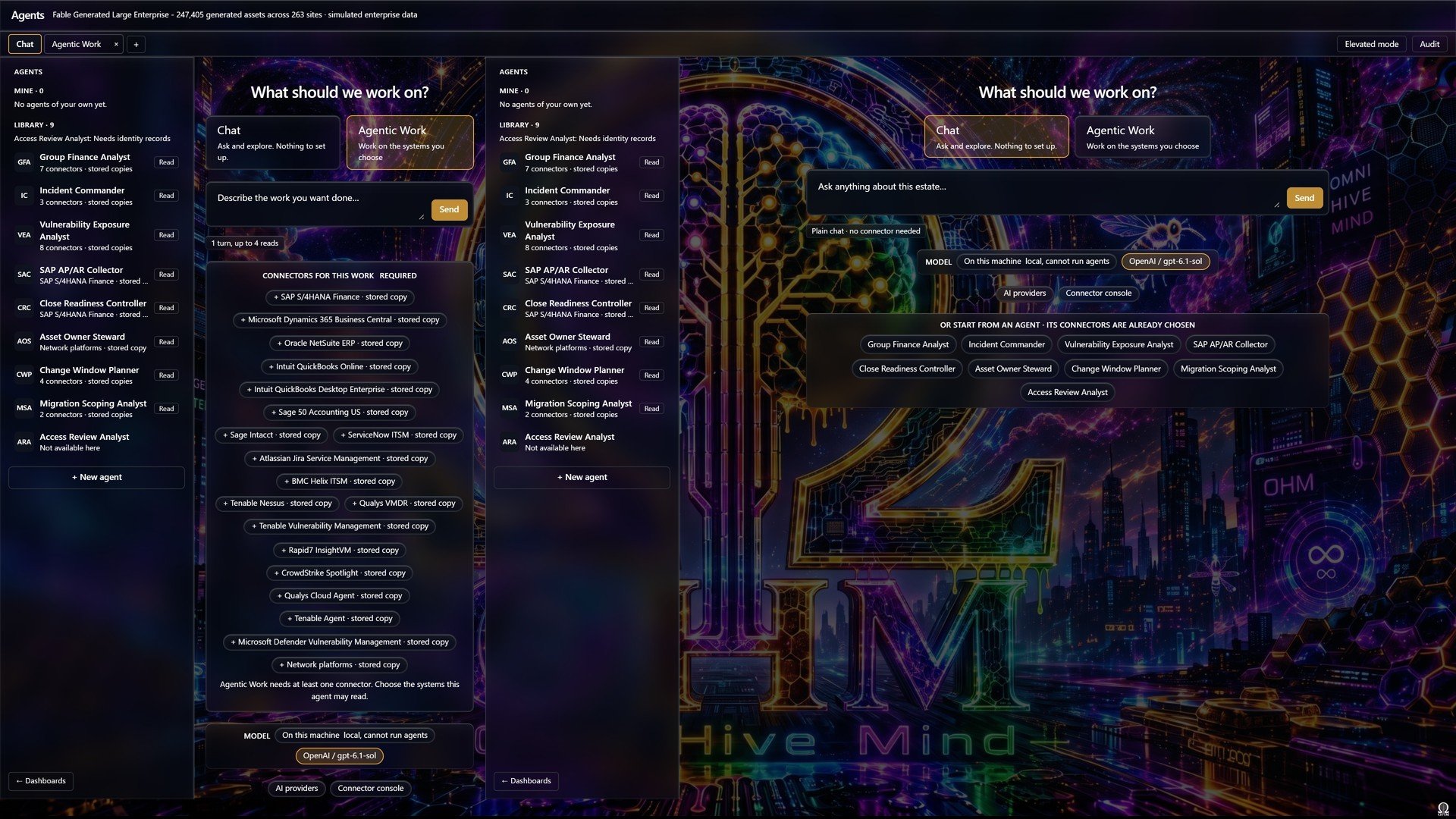
The workbench split view: Chat and Agentic Work side by side.
It proposes, a person decides
When an agent needs to do something on a system, it does not just do it. It proposes one exact command, shown word for word. A named person then has two minutes to approve or reject that exact text. The approval is bound to the text it was shown: change a character and it is a different request. Typing "yes" in a chat never counts as an approval.
Who does what is fixed:
The model plans reads and proposes steps.
OHM's server runs the reads, runs approved steps and writes the record.
A person decides.
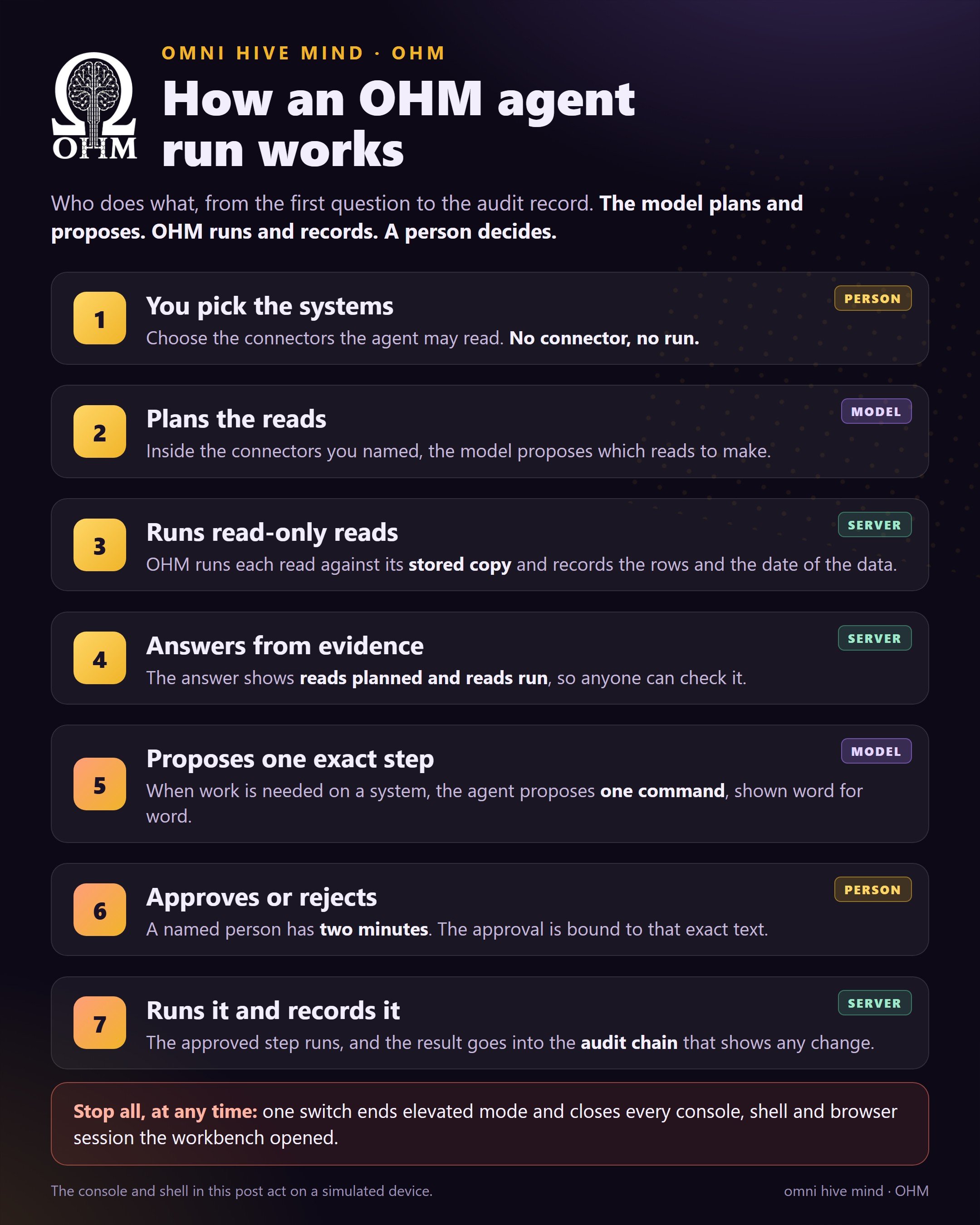
How an OHM agent run works: the model plans and proposes, OHM runs and records, a person decides.
Brakes and a record
Some work needs more access than everyday reads. In OHM that is elevated mode, and it sits behind a vault password, with a hard time limit. A single Stop all switch ends elevated mode and closes every console, shell and browser session the workbench opened, at once.
Everything that happens in the workbench goes into an audit chain: every pane opened and closed, every step proposed, approved, rejected or expired, and every session started and ended. Each entry is chained to the one before it, so the record shows if anything was changed after the fact.
Credentials never pass through the agent. They live in a separate broker process, and no screen and no API hands out a raw secret.
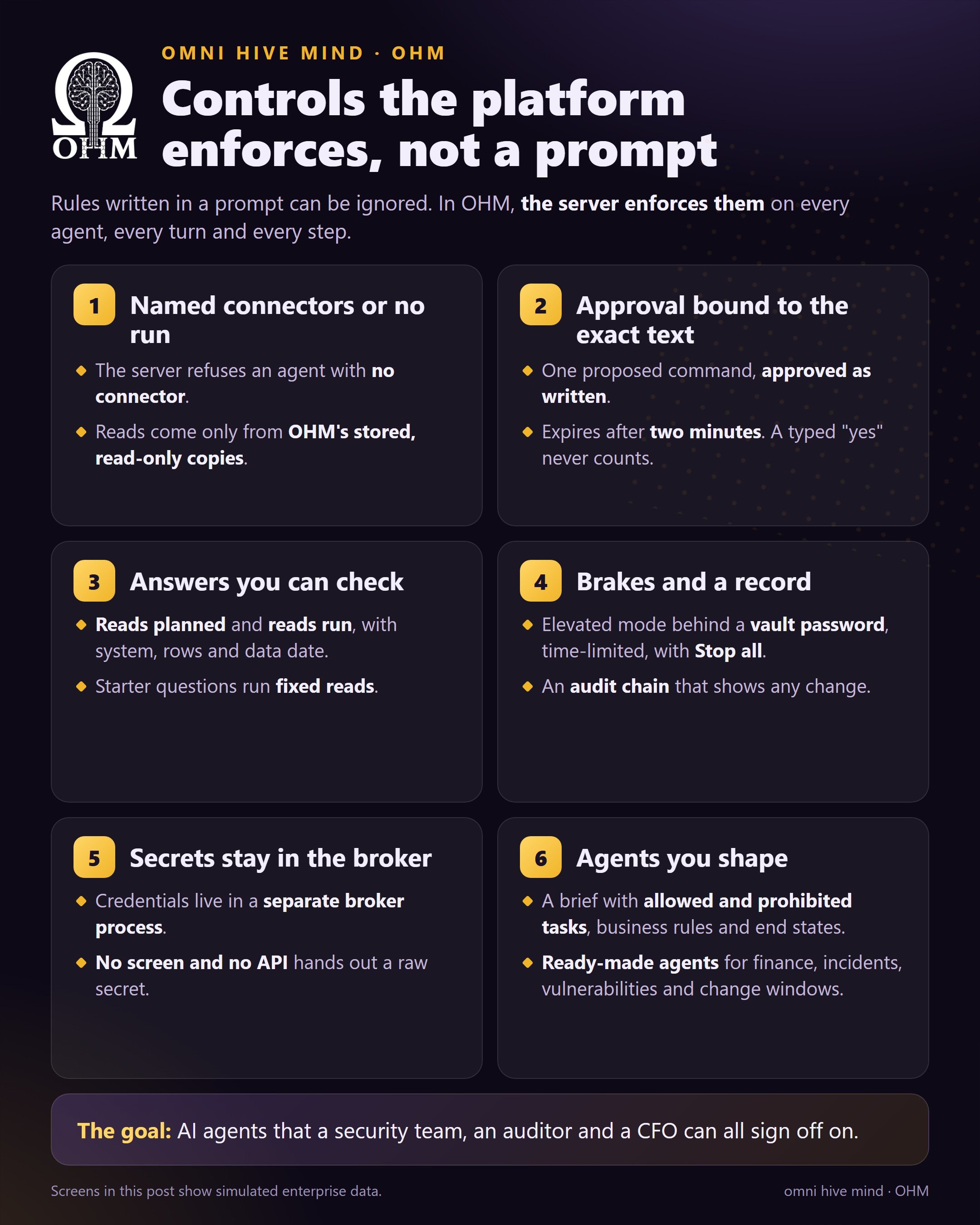
The controls OHM enforces on every agent, every turn and every step.
Coming next: the flow builder
We are designing the next step: a flow builder that lays every agent out as blocks you can read and edit. It is a design preview today, and the details may change, but the principles are set.
No template code. Conditions are picked from typed fields, not written as expressions.
The plumbing is built in. A simple agent is four blocks: Start, Brief, Reason and act, End.
Every tool is labelled. Each one is marked Read, Propose or Act.
Publishing has rules. An agent cannot be published if an Act step has no Review and Approve before it, if a tool sits outside the agent's connectors, if a loop has no limit, or if a path has no end.
Test before you publish. Step-through test runs show the state after each block. Drafts stay private, and every published version keeps a diff.
Run and design are linked. Click a line in a run to open the block that produced it.
Build with AI. Describe the job, and OHM drafts a flow, validates it, and shows it to you before anything is saved.
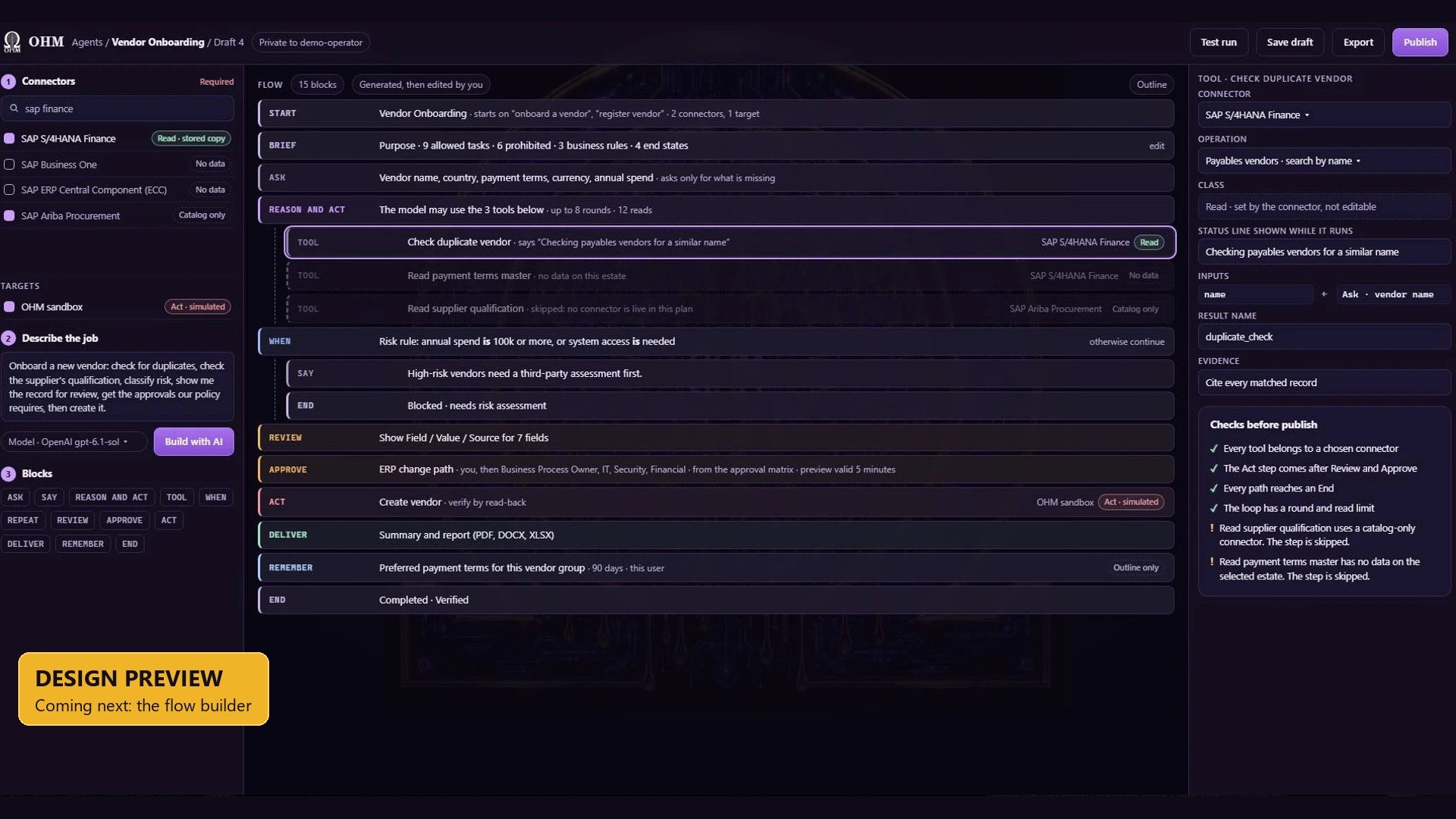
Design preview of the OHM flow builder. Simulated data.
Why we built it this way
Most enterprises still cannot answer a simple question without weeks of spreadsheets: what do we actually run? OHM exists to answer it. It finds what your enterprise really runs, checks it against what your systems of record say, and keeps the evidence.
Agents are the natural next layer, but only if they inherit that discipline. An agent that answers from evidence, shows its reads, and waits for a named person before it acts is an agent a security team, an auditor and a CFO can all sign off on. That is the standard we hold OHM's agents to.
The screens in this post use simulated enterprise data. The console and shell act on a simulated device. The flow builder is a design preview, and plans can change.
If that is the standard your organization needs, contact us for a live demonstration.
Share this post: LinkedIn · X · Facebook · Email · Follow us on Instagram